

AI-Powered Churn Prediction for SaaS: Building Early Warning Systems That Work
September 8, 2026
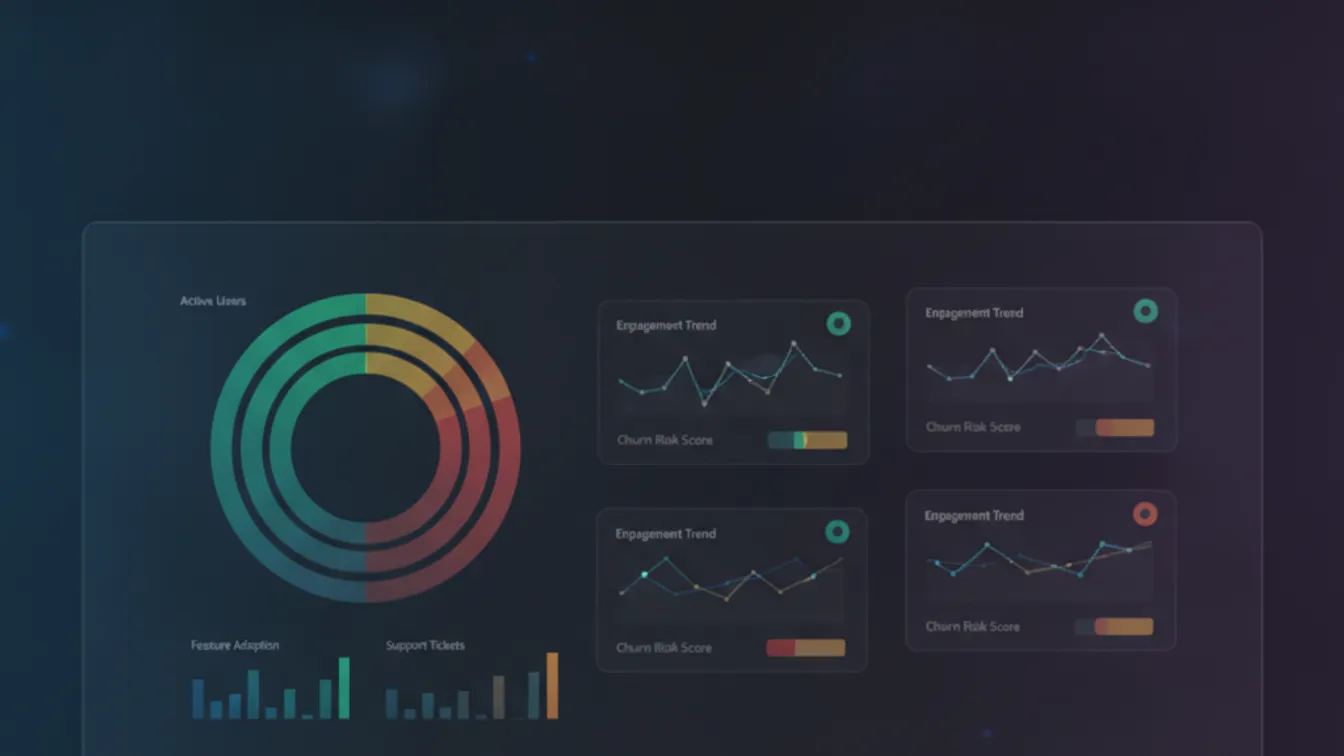
By the time a customer submits a cancellation request, the opportunity to save them is often already gone. The decision to leave was made weeks earlier—in a string of missed logins, ignored feature prompts, and support tickets that never quite resolved. The challenge for SaaS teams isn’t detecting churn after it happens; it’s predicting it early enough to intervene.
AI-powered churn prediction gives you that lead time. When built correctly, a churn model doesn’t replace your customer success team—it makes them dramatically more effective by surfacing the accounts that need attention before the cancellation email lands in your inbox.
Why Churn Prediction Matters Now More Than Ever
The economics of SaaS in 2026 leave little room for silent customer exits. With customer acquisition costs rising and growth-at-all-costs strategies out of favour, net revenue retention (NRR) has become the dominant health metric for subscription businesses.
Yet most SaaS products still rely on reactive signals: a drop in login frequency, a downgrade request, or a support ticket mentioning a competitor. These signals arrive too late. By the time a churned account shows up in your analytics dashboard, the customer has already made up their mind.
AI-powered early warning systems work differently. Instead of looking at a single behaviour, they combine dozens of signals—usage patterns, engagement trajectories, support history, billing events—and score each account continuously. The result is a risk ranking updated daily, giving your team a prioritised list of accounts to reach out to before churn becomes inevitable.
The Data You Already Have (And How to Use It)
The good news is that most SaaS products generate more than enough data to build a useful churn model. You don’t need a data warehouse with years of history to get started. You need the right signals, cleaned and structured.
The most predictive signals typically fall into three categories:
Engagement signals are the most immediate indicators of account health:
- Login frequency and recency — How often does the user log in, and when was the last session?
- Feature adoption breadth — Are they using core features only, or exploring the product deeply?
- Session depth — Are sessions getting shorter over time, suggesting the user isn’t finding value?
- Collaboration signals — In multi-seat products, has the number of active seats declined?
Lifecycle signals indicate where the customer is in their journey:
- Time since onboarding completion
- Whether the account completed key activation milestones (the “aha moment” actions your data shows correlates with long-term retention)
- Renewal date proximity
- Number of previous renewals (longer tenured accounts churn less)
Relationship signals capture the quality of the support experience:
- Open ticket count and average resolution time
- Sentiment in recent support conversations (even simple keyword matching helps)
- NPS or in-app survey scores if you collect them
- Billing events — failed payments, plan downgrades, invoice disputes
Building Your Churn Prediction Model: A Practical Approach
Step 1: Define Churn Precisely
Before touching a dataset, define what churn means for your product. For a subscription SaaS, this is usually non-renewal or explicit cancellation. But in usage-based billing it might be a sustained drop below a usage threshold. Get specific: a fuzzy definition produces a fuzzy model.
Step 2: Collect and Engineer Features
Raw event logs aren’t useful as model inputs. You need feature engineering: transforming time-series event data into numeric summaries per account per time window. Common transformations include:
- Rolling averages — Average logins over the past 7, 14, and 30 days
- Trend slopes — Is weekly usage trending up or down over the past month?
- Delta features — Change in active seats month over month
- Recency buckets — Days since last login, binned into categorical risk tiers
Many teams underestimate this step. Feature engineering is where domain knowledge pays off: the features you engineer from your product’s data will outperform any off-the-shelf model applied to raw logs.
Step 3: Choose Your Model
For churn prediction, you don’t need a sophisticated deep learning model. The goal is a calibrated probability score—a number between 0 and 1 representing how likely an account is to churn in the next 30, 60, or 90 days.
Three approaches are worth considering:
- Gradient boosting (XGBoost / LightGBM): The workhorse for tabular prediction tasks. Handles missing values, is robust to outliers, and produces well-calibrated probabilities. The best starting point for most SaaS churn models.
- Logistic regression: Simpler, faster, and highly interpretable. If your team needs to explain to stakeholders why an account is flagged as at-risk, a logistic regression with a small set of manually-curated features will often be easier to defend than a black-box gradient boosting model.
- Survival analysis (Cox PH / Kaplan-Meier): Particularly useful when you care about when churn is likely to happen, not just whether it will. This approach respects the time-dependent nature of subscription data and handles accounts of different tenures well.
Start with gradient boosting, then refine. Evaluate on held-out historical data using AUC-ROC (how well the model ranks churners above non-churners) and precision at the top k accounts (of the 50 highest-risk accounts flagged this week, how many actually churned?).
Step 4: Set Your Scoring Cadence
Run the model on a schedule—daily is common—and write the output scores to a table or CRM property your customer success team can query. A weekly summary digest to Slack or email can alert the team to accounts that crossed a risk threshold since the last run.
Integrating Predictions Into Your Product Workflow
A churn score sitting in a database nobody reads is worthless. The real value comes from wiring predictions into the workflows your team already uses.
Common integration patterns include:
- CRM enrichment — Write the churn risk score as a custom field in your CRM (HubSpot, Salesforce, Intercom). CS reps see risk scores on every account page without context-switching.
- In-app triggers — For high-risk accounts, trigger in-app tooltips, re-onboarding flows, or “we noticed you haven’t used X feature” emails automatically. AI-integrated app development makes these flows easier to personalise at scale.
- CS playbooks — Route high-risk accounts to a dedicated save playbook: an outreach email sequence, a success call, or a temporary plan credit. Lower-risk accounts get lighter-touch automated nudges.
- Product insights loop — Feed churn correlations back to your product team. If a specific workflow step correlates strongly with churn, that’s a product problem worth fixing.
Common Pitfalls to Avoid
Predicting on the training window: If you train on data from accounts that churned last quarter and score accounts from the same period, you’ll get optimistic results that don’t generalise. Always train on a period that ends before your test window.
Ignoring class imbalance: In most SaaS products, churners are a minority of accounts. A model that predicts “will not churn” for everyone is 95% accurate—and completely useless. Use oversampling (SMOTE), class-weighting, or calibrated probability thresholds to handle imbalance correctly.
Skipping the feedback loop: A model trained once on historical data will decay. Customer behaviour shifts, product changes, and market conditions alter what predicts churn. Retrain quarterly at minimum, and log model predictions so you can measure real-world precision over time.
Conflating correlation with causation: A low login count correlates with churn, but that doesn’t mean forcing logins reduces churn. Treat model outputs as signals for human-led interventions, not as automated verdicts to act on blindly.
Getting Started Without a Data Science Team
You don’t need a dedicated ML engineering team to run a production-grade churn model. Many SaaS teams get their first model running with a single backend engineer and a data analyst—especially if you’re using managed platforms like AWS SageMaker, Google Vertex AI, or Azure ML that handle infrastructure, retraining pipelines, and model serving out of the box.
If your product data isn’t yet structured for this kind of analysis, the first milestone is simpler: build a health score dashboard in your analytics tool using a weighted combination of engagement signals. Even a rule-based score that buckets accounts into green/yellow/red gives your CS team something to act on immediately, while you build toward a trained model.
The path from zero to a working churn early warning system is rarely a single engineering sprint—but teams that commit to it consistently report a meaningful improvement in net revenue retention within two to three quarters.
Predicting churn accurately is an engineering problem. Turning those predictions into revenue-saving interventions is a product and process problem. The teams that solve both outperform their peers on NRR—the metric that increasingly determines whether a SaaS business can grow sustainably.
If you’re building or scaling a SaaS product and want to embed AI-powered retention capabilities from the ground up, talk to our team about how Nevrio approaches AI/ML integration for SaaS products — from feature engineering to production model deployment.
