
AI Governance for SaaS Products: Navigating the EU AI Act in 2026
October 18, 2026
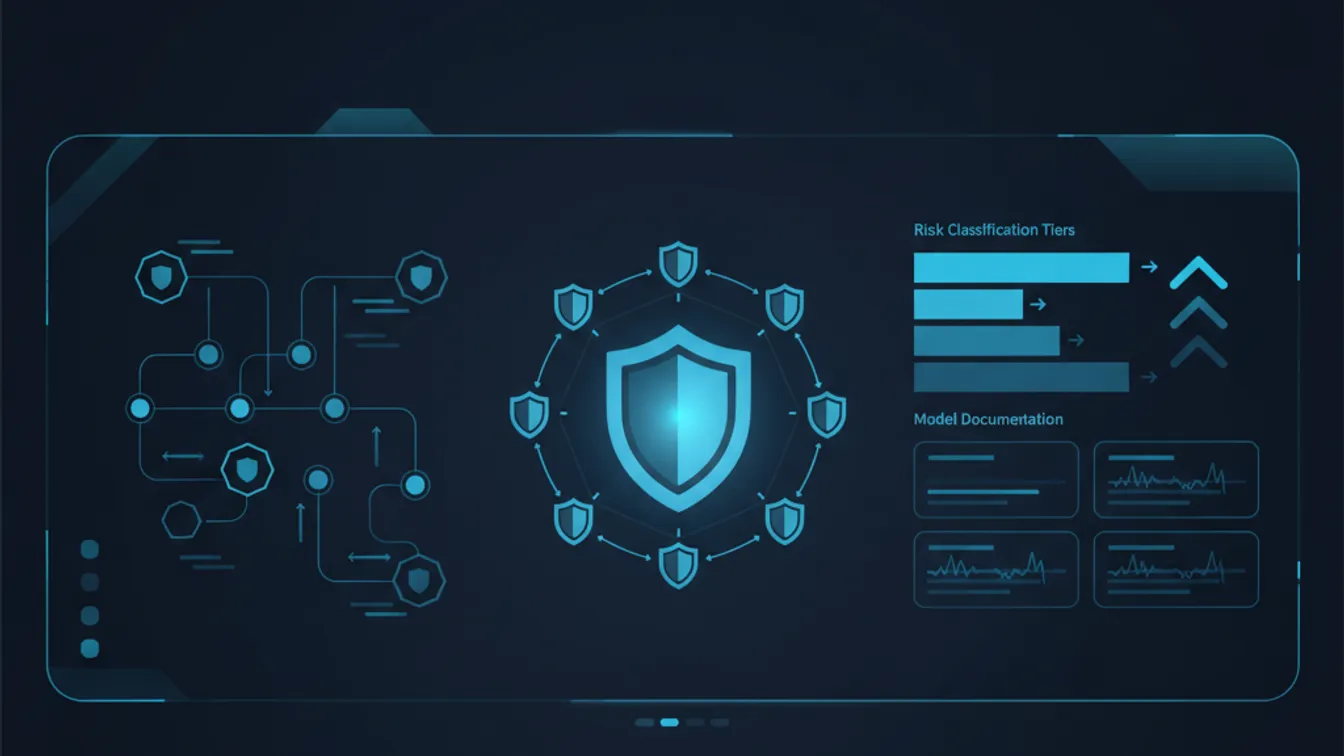
The EU AI Act is no longer a looming deadline — it is fully in force. SaaS products that deploy AI features to users in the European Union are now subject to legally binding requirements around risk classification, transparency, human oversight, and documentation. Regulators are actively reviewing high-risk AI systems, and fines for non-compliance reach up to €35 million or 7% of global annual turnover.
For most SaaS teams, the reaction swings between two extremes: paralysis (“we’ll pull the AI features until we figure this out”) or denial (“this only applies to facial recognition and autonomous vehicles”). Neither is accurate. The path forward is a practical AI governance framework built into your engineering and product processes — one that lets you move fast, stay compliant, and build user trust at the same time.
Understanding the EU AI Act’s Four Risk Tiers
The Act classifies AI systems by the severity of harm they can cause. Your compliance obligations depend entirely on which tier your product falls into.
Unacceptable risk (prohibited): Systems that manipulate users subliminally, exploit vulnerable groups, deploy real-time biometric surveillance in public spaces, or assign social scores. These are banned outright.
High risk: Systems used in consequential decisions about people — hiring, credit, education, healthcare, law enforcement, critical infrastructure. If your SaaS product automates a hiring funnel, recommends loan terms, or assists clinical decisions, you are almost certainly in this tier.
Limited risk: Systems with transparency obligations. Chatbots must tell users they are interacting with an AI. AI-generated content must be labeled as such. Most general-purpose B2B SaaS features land here.
Minimal risk: Spam filters, AI-assisted search, recommendation engines (where the stakes are low), and AI writing aids. No specific requirements — but documenting your reasoning is still good practice.
The practical first step is not a legal audit. It is a feature inventory: list every AI-driven decision in your product, identify the end use case and affected user, and map each feature to one of these tiers.
What High-Risk Compliance Actually Requires
If any of your features fall under high risk, the Act mandates six core controls. Each one maps to engineering and product decisions you can make now.
1. Risk Management System
Maintain a documented risk management process covering the AI system’s lifecycle — from design through deployment and deprecation. This is not a one-time doc; it is a living record updated on every material change to the model or its use case.
2. Training Data Governance
Document your training data: source, scope, cleaning steps, known biases, and the measures taken to mitigate them. If you fine-tune a foundation model on customer data, that documentation extends to the fine-tuning dataset.
3. Technical Documentation and Model Cards
For each AI feature, maintain a model card that captures: the model’s intended purpose and scope, its architecture and training approach, performance metrics across demographic subgroups, known limitations, and the human oversight mechanism. The EU Act specifies the minimum fields; the technical documentation must be available to regulators on request.
4. Record-Keeping (Logging)
High-risk systems must maintain logs sufficient to trace the system’s inputs, outputs, and any human interventions. For SaaS, this typically means structured event logging on every AI-assisted decision, retained for the period specified in your data-retention policy. Your existing observability stack can handle this — the requirement is that logs exist and are queryable.
5. Transparency Toward Users
Users interacting with a high-risk AI system must be informed that they are doing so, what the system’s capabilities and limitations are, and that a human is available for review. Practically: clear UI labeling, inline disclosures on AI-generated outputs, and an accessible escalation path.
6. Human Oversight
The system must be designed so that a human operator can monitor it in real time, understand its outputs, and override or shut it down. Autonomous decision loops with no human review point are non-compliant for high-risk applications. This shapes architecture decisions: your AI pipeline needs an interruption mechanism, and the UX needs to make override actions discoverable.
Building an AI Governance Framework Your Team Can Actually Use
Compliance documentation written once and filed away does not constitute governance. Sustainable AI governance is a set of lightweight processes embedded in the development workflow.
Add an AI impact assessment to your feature spec template. Before any AI feature enters the sprint, the spec should answer: what is the feature’s risk tier, who are the affected users, what data does it use, what is the human oversight mechanism, and what is the rollback plan? This takes 30 minutes per feature and creates the paper trail you need.
Treat model updates as deployable events. A silent capability shift in a cloud-hosted model — or a quiet retraining of your own model — can change behavior your compliance documentation describes as stable. Apply the same change-management rigor to model updates that you apply to API releases: versioning, release notes, regression evals, and a rollback path.
Establish a bias testing gate in CI. For any model that influences outcomes for specific user groups, run a bias and fairness evaluation as part of the deployment pipeline. Libraries like Fairlearn, AI Fairness 360, and Deepchecks can be integrated into a standard test suite. A failed bias gate blocks the deploy — the same way a failed unit test does.
Assign an AI accountability owner. Governance without ownership drifts. Designate someone — a staff engineer, a product manager, or a dedicated AI safety role as your team scales — who is responsible for maintaining the feature inventory, the model documentation, and the risk management records. This does not need to be a full-time role at early scale; it needs to be someone’s defined responsibility.
The Trust Dividend
Compliance carries a cost. But the teams that build governance into their process early — rather than retrofitting it under regulatory pressure — earn a competitive advantage that goes beyond avoiding fines.
Enterprise buyers, especially in healthcare, finance, and logistics, increasingly require AI transparency as a procurement condition. A SaaS product with a published model card, a clear disclosure policy, and a documented risk management framework closes B2B deals that a product without those artifacts will lose.
The EU AI Act is not the end state; it is the floor. The US, UK, and other major markets are converging on similar frameworks. The investment in AI governance you make today applies across every jurisdiction your product enters.
Building responsible AI features at scale requires both regulatory knowledge and deep engineering capability. If your team is navigating high-risk AI compliance or embedding governance into your AI integration or SaaS product development process, we can help you design a framework that is audit-ready without slowing your roadmap.
Start a project with Nevrio’s AI engineering team — or contact us to discuss your compliance roadmap.
