
Multi-Tenant SaaS Architecture: Patterns and Trade-offs Every Founder Should Know
October 16, 2026
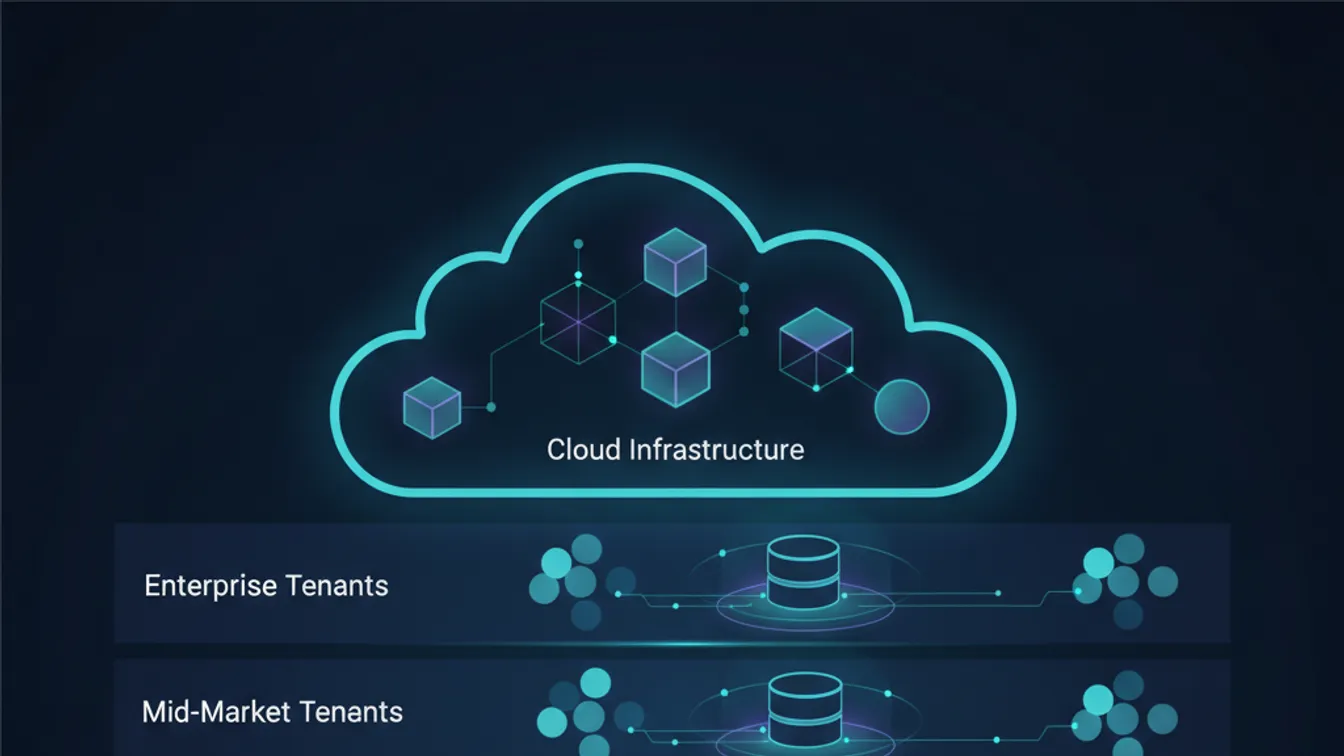
If you’re building a SaaS product, “multi-tenancy” is one of the first architectural decisions you’ll make — and one of the hardest to reverse later. Get it right early and your platform can serve hundreds of customers on shared infrastructure with strong isolation and low cost. Get it wrong and you’ll spend months retrofitting security boundaries or migrating databases mid-growth. This guide breaks down the three core isolation models, the trade-offs that define each, and a practical framework for choosing the one that fits where you are today.
What Multi-Tenancy Actually Means
A multi-tenant SaaS serves multiple customers — tenants — on shared infrastructure while keeping each tenant’s data logically (and often physically) separate. It’s the foundation of every major SaaS business from Salesforce to Figma, and the architecture decision that shapes nearly everything downstream: data access patterns, performance, compliance posture, billing, and onboarding.
The alternative — spinning up a dedicated instance per customer — is sometimes called a “single-tenant” or “silo-first” model. It’s simpler to reason about but expensive to operate and complicated to maintain across many customers. Most scalable SaaS products land somewhere on a spectrum between full sharing and full isolation, and the right position on that spectrum depends on your customer profile, compliance requirements, and growth stage.
The Three Core Isolation Models
Pool Model: Shared Database, Shared Schema
In the pool model, all tenants share a single database and a single schema. Rows are tagged with a tenant_id column, and every query filters on it. Think of it as one big table with a “whose data is this?” column.
Advantages: Maximum infrastructure efficiency. One database to manage, one schema to migrate, low per-tenant overhead. Excellent for early-stage products with many small customers.
Drawbacks: Security relies entirely on application-level filtering. A missing WHERE tenant_id = ? clause exposes cross-tenant data. Performance is shared — a noisy tenant can affect everyone. Regulatory frameworks like HIPAA or SOC 2 may require stronger isolation than this model provides.
Best fit: Consumer SaaS, SMB-focused products, freemium tiers, and early MVPs where simplicity and cost matter more than hard isolation guarantees.
Bridge Model: Shared Database, Separate Schemas
The bridge model keeps all tenants in a single database instance but gives each tenant their own schema (in PostgreSQL) or namespace (in some other databases). Data stays isolated at the schema level, and the application dynamically sets the search path or schema name based on the authenticated tenant.
Advantages: Strong data isolation without the cost of separate databases. Schema-level isolation means one bad query can’t leak to another tenant. Migrations can be batched across schemas, and a single database server handles the operational load.
Drawbacks: Schema proliferation gets unwieldy above a few hundred tenants. Migrations must be applied to every tenant schema, which adds complexity and time. Cross-tenant analytics (usage reporting, aggregated dashboards) require cross-schema queries or a separate analytics layer.
Best fit: B2B SaaS with medium-sized customers, regulated industries where data isolation matters, or products that have outgrown the pool model but aren’t ready for per-tenant databases.
Silo Model: One Database Per Tenant
The silo model gives every tenant a completely isolated database. No shared tables, no shared schema — full physical separation. Each tenant’s data lives on its own infrastructure.
Advantages: The strongest possible isolation. Perfect for enterprise customers who contractually require data residency, dedicated infrastructure, or the ability to export and delete their data cleanly. Blast radius of a breach or bug is contained to a single tenant.
Drawbacks: Expensive to operate. Hundreds of databases mean hundreds of connection pools, migrations, and backups. Onboarding a new tenant requires provisioning infrastructure, which adds latency and complexity. Cost-per-tenant is high.
Best fit: Enterprise SaaS, heavily regulated verticals (healthcare, financial services, government), or customers with contractual isolation requirements. Often the right model for a tier above your standard offering — think “Enterprise Plan” while lower tiers share a pool or bridge.
Tenant Identification and Routing
Regardless of isolation model, every request needs to identify which tenant it belongs to before any data access happens. The three common strategies:
- Subdomain routing:
acme.yourapp.com— clean UX, easy to extract in middleware, works well with wildcard TLS certificates. - Path prefix:
yourapp.com/acme/— simpler infrastructure, no wildcard cert needed, but less clean branding for customers. - JWT or session claims: the tenant identifier is embedded in the auth token and extracted server-side. Works well with any URL structure and is easy to enforce at the API layer.
Whichever strategy you choose, enforce tenant resolution as close to the entry point as possible — in middleware or an authentication layer — so no request can accidentally bypass the filter.
Security and Data Isolation That Actually Holds
Architecture is the first layer. Application code is where it breaks. A few practices that consistently prevent cross-tenant leaks:
- Row-level security (RLS) in PostgreSQL: the database enforces the tenant filter even if application code forgets to. This is one of the strongest defenses available in the pool model and requires no application changes to be effective for queries.
- Scoped API keys: tokens issued to a tenant’s users are scoped to that tenant at the identity layer, so a compromised key can only reach its own data.
- Audit logging per tenant: record every data access with the tenant ID. This is table-stakes for SOC 2 and essential for incident response.
- Automated testing: write integration tests that deliberately try to access another tenant’s data with a valid but wrong-tenant token. If those tests can pass, your isolation has a hole.
Building for compliance from day one — whether that’s HIPAA, GDPR, or SOC 2 — is dramatically cheaper than retrofitting it after you’ve signed enterprise customers. If your target market includes regulated industries, the isolation model you choose now determines the compliance ceiling you can reach later.
When to Switch Models as You Scale
Most successful SaaS products start with the pool model for speed and cost, then migrate toward bridge or silo as enterprise demand grows and compliance requirements tighten. The trigger points that typically force a migration:
- Enterprise deals stalling: a prospect’s security team requires data isolation you can’t prove.
- Performance degradation: one or two large tenants are affecting everyone else’s experience.
- Compliance certifications: SOC 2 Type II or HIPAA audits reveal gaps in your current isolation posture.
- Data residency requirements: a customer’s legal team requires their data to stay in a specific geography.
Migrations between models are expensive but not impossible. The teams that do them cleanly treat it as a product project, not just an infrastructure lift: tenant migration tooling, shadow-write periods, and thorough testing before cutting over.
A Practical Checklist Before You Build
Before you commit to an isolation model, answer these questions:
- Who are your first customers? SMBs and prosumers → start pool. Mid-market or regulated → start bridge.
- What compliance frameworks will you need? HIPAA, SOC 2, or ISO 27001 requirements should inform the isolation floor.
- How many tenants do you expect in year one? Dozens → any model works. Thousands → pool or bridge.
- What’s your team’s operational maturity? Silo adds real operational overhead — make sure you have the tooling and team to manage it.
- Is there a premium tier where stronger isolation is a feature? If so, design for tiered isolation from the start.
Build the Right Foundation, Then Scale It
Multi-tenancy isn’t a feature you bolt on — it’s an architectural commitment that flows through your data model, your auth layer, your migrations, and your compliance posture. Choosing the right model early, and being intentional about when to evolve it, is one of the highest-leverage decisions in early-stage SaaS product development.
If you’re designing a new product or need to evolve an existing multi-tenant architecture, Nevrio’s team has shipped this across dozens of SaaS platforms — from MVP stage through enterprise scale. We’ll help you pick the right isolation model for your customer profile and make sure the foundation holds as you grow.
Start your SaaS architecture conversation — or contact our team to talk through your specific use case.
