

Omnichannel Retail Technology: How to Build a Unified Commerce Platform in 2026
July 31, 2026
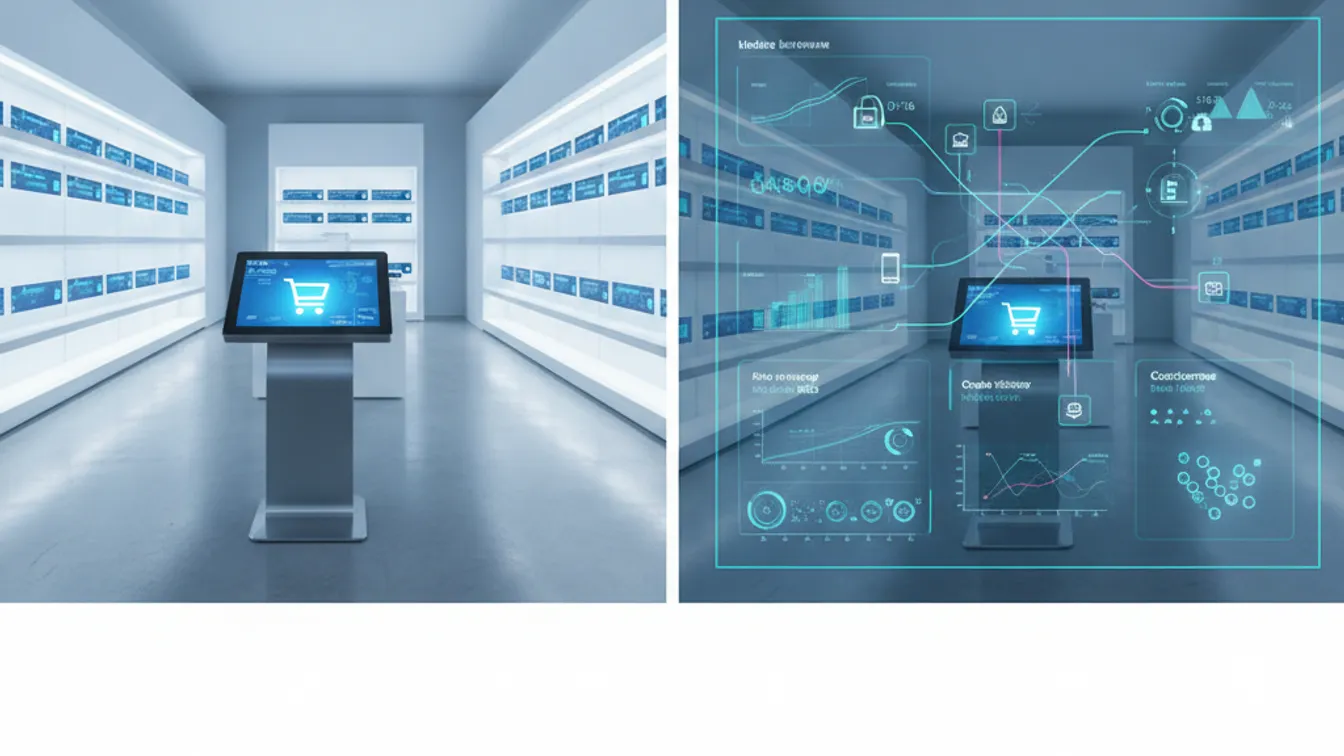
Shoppers no longer separate “online” from “in-store.” They browse on Instagram, compare prices on a mobile app, try the item in a physical store, and complete the purchase through a chatbot — all for the same product, sometimes within the same hour. Retailers who treat each of those touchpoints as a separate system lose sales, frustrate customers, and burn engineering hours on data reconciliation. Retailers who unify them — a single source of truth for inventory, orders, customers, and product data — consistently outperform on conversion, retention, and operational efficiency.
This guide is for technology leads and founders building or re-platforming retail software. It covers the architecture decisions that determine whether an omnichannel investment pays off, the components you must get right, and the places where AI is creating the most measurable lift in 2026.
What “Unified Commerce” Actually Means
The industry has used “omnichannel” for a decade. In practice, many retailers achieved coordination between channels rather than true unification — separate inventory pools synchronized by cron jobs, separate customer records merged in a weekly ETL, separate order systems loosely coupled by webhooks. When something breaks (and it always does), the customer experience breaks first.
Unified commerce is the architectural evolution: a single platform layer — often called a commerce kernel — that owns the authoritative state for products, inventory, customers, and orders, and exposes it to every channel through APIs. A mobile app, a web storefront, a point-of-sale terminal, a voice assistant, and a B2B portal all read from and write to the same data. There is no sync lag because there is nothing to sync — the channel is just a presentation layer over shared state.
The Architecture Layers That Matter
1. Headless Storefront Layer
A headless approach decouples the customer-facing frontend from the commerce engine. Your Astro or Next.js storefront, your React Native mobile app, your in-store kiosk UI — each is an independent frontend that calls the same commerce API. This gives your design team full creative control without touching the backend, and lets you ship a mobile redesign without touching order management.
The practical implication: your commerce API must be fast (sub-100ms P99 for product and cart endpoints), well-documented, and versioned. GraphQL is the dominant choice for headless retail because it lets each frontend fetch exactly the shape it needs in a single request — critical for mobile clients on constrained connections.
2. Centralized Product Information Management (PIM)
Products live once, in one place. The PIM is the canonical record for every product attribute, variant, media asset, and localization. Every channel — web, mobile, POS, marketplace integrations — reads from the PIM. When a brand manager updates a product description or swaps a hero image, every channel reflects it immediately.
For mid-market and enterprise retailers, purpose-built PIMs (Akeneo, Plytix, Pimcore) are worth evaluating. For startups or emerging brands, a well-structured headless CMS with commerce extensions often covers the same ground at a fraction of the cost and integration effort. The key is that no channel owns its own product data; all product writes go to one system.
3. Distributed Order Management System (DOM)
Order management is where omnichannel complexity peaks. A customer places a web order, requests in-store pickup, then calls support to ship half the items to a different address. Each of those state transitions touches inventory, fulfillment, payment, notifications, and possibly a third-party logistics provider — simultaneously, and in a way that remains consistent if any one of those systems is slow.
A distributed order management system models an order as a state machine and routes each line item to the optimal fulfillment source — warehouse, store, drop-ship vendor — based on inventory availability, cost, and SLA. The most common architecture uses an event-driven backbone (Kafka or AWS EventBridge for high volumes; SQS for most mid-market setups) to decouple the order intake from fulfillment, payment capture, and notification systems, so a slow carrier API can’t block a customer checkout.
4. Real-Time Inventory Across All Nodes
Inventory is the hardest data consistency problem in retail. Stock can exist in a central warehouse, spread across 50 store locations, in transit with a carrier, reserved in a pending cart, or allocated to a marketplace fulfillment partner — all at the same time. Showing a customer an accurate availability promise, across a headless storefront that handles thousands of concurrent sessions, requires an inventory service that writes count changes as events (not polling updates) and provides a low-latency read path, often backed by Redis or a specialized inventory ledger service.
The architecture choice that pays off: model inventory as a set of reservations and adjustments (a ledger), not a mutable count. Each cart reservation debits the ledger; each cancellation credits it. The ledger is append-only, auditable, and naturally concurrent — compared to update-on-read patterns that cause oversell under load.
5. Unified Customer Profile
A customer who bought in-store twice and browsed online six times is one customer — but many retail systems hold them as three different records. Unified customer identity, built on a customer data platform (CDP) or a purpose-built identity resolution layer, merges signals from every touchpoint into a single profile with full purchase and interaction history.
This isn’t just a data hygiene concern. A unified profile is the foundation for real-time personalization, loyalty program accuracy, support ticket context, and compliant marketing consent management. Without it, personalization engines and loyalty programs operate on partial data and consistently underperform.
Where AI Is Creating Measurable Lift in 2026
Personalization, demand forecasting, and visual search have all matured significantly in the last year, and the gap between retailers using them and those relying on rule-based systems is visible in revenue metrics.
AI-driven personalization at the channel level — serving different product rankings, promotional content, and bundle recommendations based on each customer’s real-time behavioral signals — is delivering measurable conversion lifts of 15–30% on product listing pages. In 2026, the models doing this are running on lightweight embeddings served from an edge inference layer, not cloud API calls, which keeps latency low enough for the homepage and search results.
Predictive inventory allocation uses historical sales velocity, upcoming promotions, and external signals (weather, local events) to pre-position inventory closer to demand before it materializes. This reduces emergency replenishment costs and out-of-stock rates without increasing average inventory levels — a meaningful margin improvement for retailers with thin unit economics.
Agentic post-purchase automation is the newest pattern gaining adoption: AI agents that handle routine post-purchase workflows — return initiation, delivery exception resolution, loyalty point queries — without involving a human agent. Paired with a unified order and customer profile, these systems resolve the majority of support contacts autonomously, at a quality that customers find acceptable. See Nevrio’s guide to AI-integrated app development for the implementation patterns that work in production.
Common Pitfalls to Avoid
Migrating everything at once. Re-platforming a live retail system in a big-bang migration is high risk. The pattern that works: implement the commerce kernel alongside existing systems, route new channels to it, and migrate legacy channels one by one after proving stability.
Treating inventory sync as eventual consistency. For most commerce workloads, inventory needs to be consistent within seconds, not minutes. Design for strong consistency at the reservation layer even if the reporting layer is eventually consistent.
Underspecifying the POS integration. Physical stores often have legacy POS hardware with limited API support. The integration layer between your unified commerce platform and in-store systems typically requires more engineering time than expected — plan for it explicitly.
Skipping a proper identity resolution strategy. Merging customer records after the fact is painful. Define your identity resolution rules (email as primary key, phone as secondary, loyalty ID as tertiary) before you build the unified profile, not after.
Building vs. Buying the Platform
Most retailers in 2026 use a composable stack: a best-of-breed PIM, a purpose-built commerce engine (Commercetools, Medusa, or Elastic Path for enterprise; Shopify Plus for mid-market), and custom-built layers for the specific workflows — order orchestration, inventory allocation, loyalty — where their business model is differentiated.
The custom layers are where a product engineering partner makes the difference. A unified commerce platform is not one product you can buy and configure — it’s an architecture you compose from building blocks and connect with custom logic that encodes your specific fulfillment rules, pricing models, and customer experience decisions.
If you’re planning to re-platform a retail system or build a unified commerce foundation from scratch, the architecture decisions you make in the first quarter determine your flexibility for the next five years.
Start your omnichannel platform project with Nevrio — or reach out to discuss your architecture before you commit to a stack.
