
RAG vs Fine-Tuning: Choosing the Right AI Customization Strategy for Your SaaS
October 8, 2026
Every SaaS team adding AI to their product hits the same fork in the road: do you use retrieval-augmented generation (RAG) to give the model access to your data, or do you fine-tune a model on your domain? The answer isn’t obvious, and picking the wrong approach costs months of engineering time and tens of thousands of dollars in compute. This guide gives you a clear framework to make the right call before you write a single line of training code.
What RAG and Fine-Tuning Actually Do
Before comparing them, it’s worth being precise about what each technique changes.
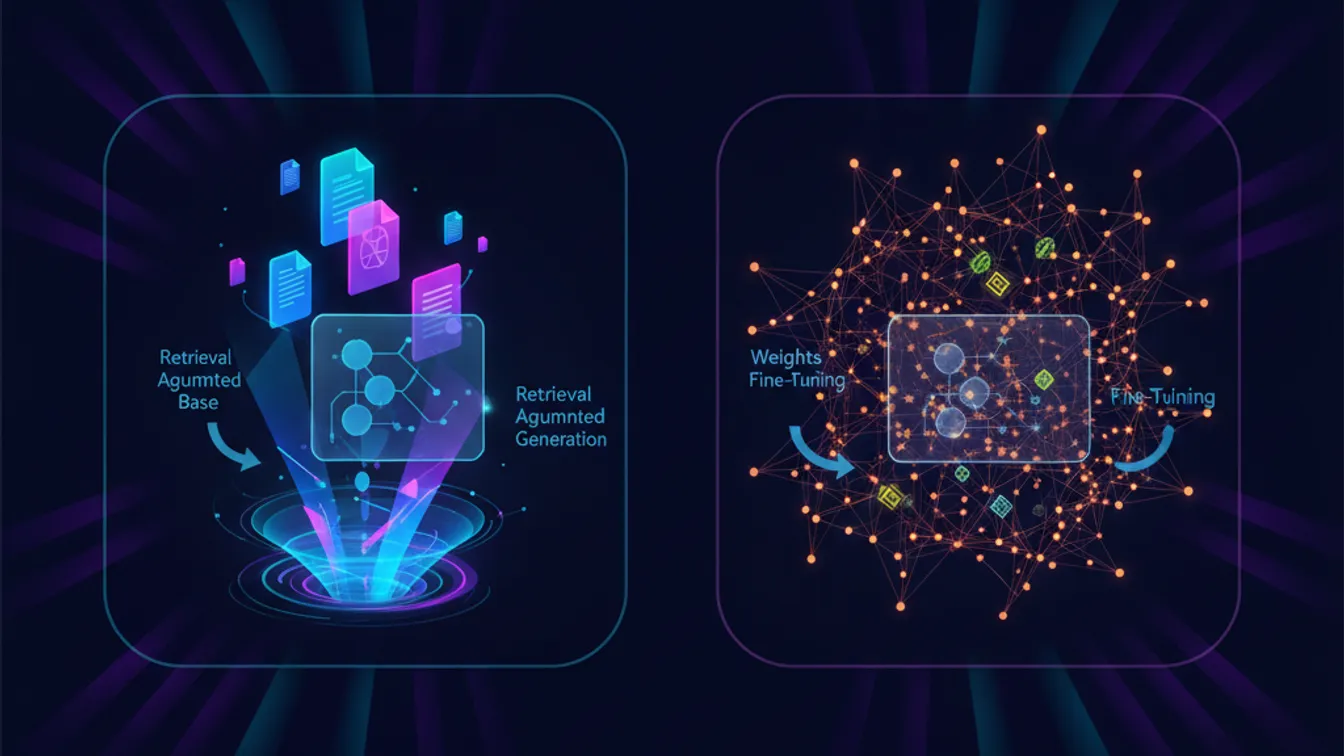
RAG doesn’t change the model at all. Instead, it builds a retrieval layer — typically a vector database — that fetches relevant chunks of your documents, knowledge base, or product data at query time and injects them into the model’s context window. The model reasons over that retrieved content to produce a grounded, up-to-date answer.
Fine-tuning changes the model’s weights by training it further on your own data. The model learns your domain vocabulary, your preferred response format, and the patterns in your corpus. After fine-tuning, the knowledge is baked in — no retrieval step required.
Both approaches let you move beyond a generic out-of-the-box LLM. They solve different problems.
The Core Trade-Offs
Knowledge freshness
RAG wins here by default. Your retrieval index can be updated in minutes — index a new document and the model can immediately cite it. With fine-tuning, stale knowledge is expensive: you’ll need to re-run training (or at least incremental fine-tuning) every time your knowledge base changes meaningfully.
If your product deals with frequently changing content — support docs, compliance policies, product catalogs, regulatory updates — RAG is almost always the right foundation.
Format and style control
Fine-tuning wins here. If you need the model to produce output in a highly specific format (a structured JSON schema, a branded tone of voice, a domain-specific vocabulary), few-shot prompting and RAG can get you 80% of the way there, but fine-tuning gets you the last 20% reliably. Legal AI tools, medical documentation assistants, and financial report generators often justify fine-tuning for this reason alone.
Factual grounding and hallucination control
RAG wins again. When the model is required to cite a source or stay strictly within known facts, RAG provides a traceable retrieval chain. You can show the user exactly which document a claim came from — a requirement in healthcare, finance, and any compliance-sensitive vertical. Fine-tuned models can still hallucinate; the training just shifts what they hallucinate about.
Cost and infrastructure
This one is nuanced:
- RAG requires a vector store (Pinecone, pgvector, Weaviate, Qdrant, etc.), an embedding model, and chunking/indexing logic. Operational complexity is moderate, but you pay per query rather than per training run. Latency is higher than a pure inference call because of the retrieval step.
- Fine-tuning requires GPU access, data preparation, evaluation pipelines, and model hosting. The upfront cost is significant ($500–$50,000+ depending on model size and data volume). After training, inference can actually be cheaper than using a large frontier model via API, which matters at scale.
For most early-stage SaaS products, RAG is cheaper to start, and fine-tuning pays off only once volume is high enough to absorb the training investment.
A Decision Framework You Can Actually Use
Run through these four questions in order:
1. Does your application need current or frequently updated information?
Yes → RAG. Fine-tuning on data that changes monthly is a treadmill; you’ll spend more time re-training than shipping features.
No → continue.
2. Do you need strict output format control or domain-specific behavior the model doesn’t exhibit out of the box?
Yes → fine-tuning is worth evaluating. If a carefully engineered system prompt still produces inconsistent output after extensive testing, fine-tuning is the right lever.
No → continue.
3. Is your knowledge base large enough to fine-tune on?
Fine-tuning needs quality examples, not just volume — but a useful rule of thumb is 500–1,000 high-quality input/output pairs for instruction tuning. Below that threshold, few-shot prompting with RAG will almost always outperform.
Too little data → RAG + few-shot prompting.
4. Is your inference volume high enough to recover fine-tuning costs?
If you’re making millions of API calls per month, fine-tuning to a smaller, cheaper model can meaningfully reduce your per-query cost. If you’re at hundreds or low thousands of daily queries, the API cost savings won’t recoup training costs for a long time.
Low volume → RAG on a foundation model API. High volume with stable knowledge → fine-tuning to a smaller model may pay back.
What Most SaaS Products Actually Do in 2026
The practical reality: the majority of SaaS AI features ship with RAG as the primary mechanism, sometimes layered on top of a lightly fine-tuned model for style consistency. Pure fine-tuning without any retrieval is rare outside of very specialized domains.
A common architecture:
- Foundation model (GPT-4o, Claude Sonnet, Gemini Pro, or an open model like Llama) for reasoning.
- Vector store with your product and knowledge data, updated continuously.
- System prompt that locks down tone, format, and policy.
- Optional fine-tuned adapter for domain-specific vocabulary or output structure.
This hybrid gives you freshness and grounding from RAG, style control from fine-tuning, and the raw capability of a frontier model — without betting the whole feature on one approach.
Common Mistakes to Avoid
Jumping to fine-tuning before RAG is working. Fine-tuning is an amplifier — it makes good retrieval better and bad retrieval worse. If your RAG pipeline is producing irrelevant chunks, fine-tuning won’t save it; fix retrieval first.
Under-investing in chunk strategy. The most common RAG failure isn’t model quality — it’s chunking. Too large, and the retrieved context is noisy. Too small, and the model loses meaning. Semantic chunking (splitting on meaning, not token count) outperforms fixed-size chunking in almost every benchmark.
Ignoring evaluation. “It looks good in a demo” isn’t a test suite. Build a small golden set of questions and expected answers early. Both RAG and fine-tuning require systematic evaluation to improve — without it, you’re flying blind.
Forgetting about access control. RAG systems that pull from a shared index can surface documents a user isn’t authorized to see. At the retrieval layer, not the prompt layer, is where you enforce document-level permissions.
Where Nevrio Fits
Whether your team needs a RAG pipeline integrated into an existing SaaS product or a full AI feature built from the ground up, the engineering decisions above come up in every engagement. Our AI integration services cover architecture, retrieval design, model selection, and the production infrastructure required to keep an AI feature reliable at scale.
If you’re earlier-stage and want a strategic conversation about which approach fits your roadmap, our AI agents and automation practice works with product and engineering teams to scope the right solution before any code is written.
Start a project with Nevrio’s AI team — we’ll help you pick the right approach and build it to production quality.
