

SaaS Billing and Subscription Management: Architecture and Best Practices for 2026
July 9, 2026
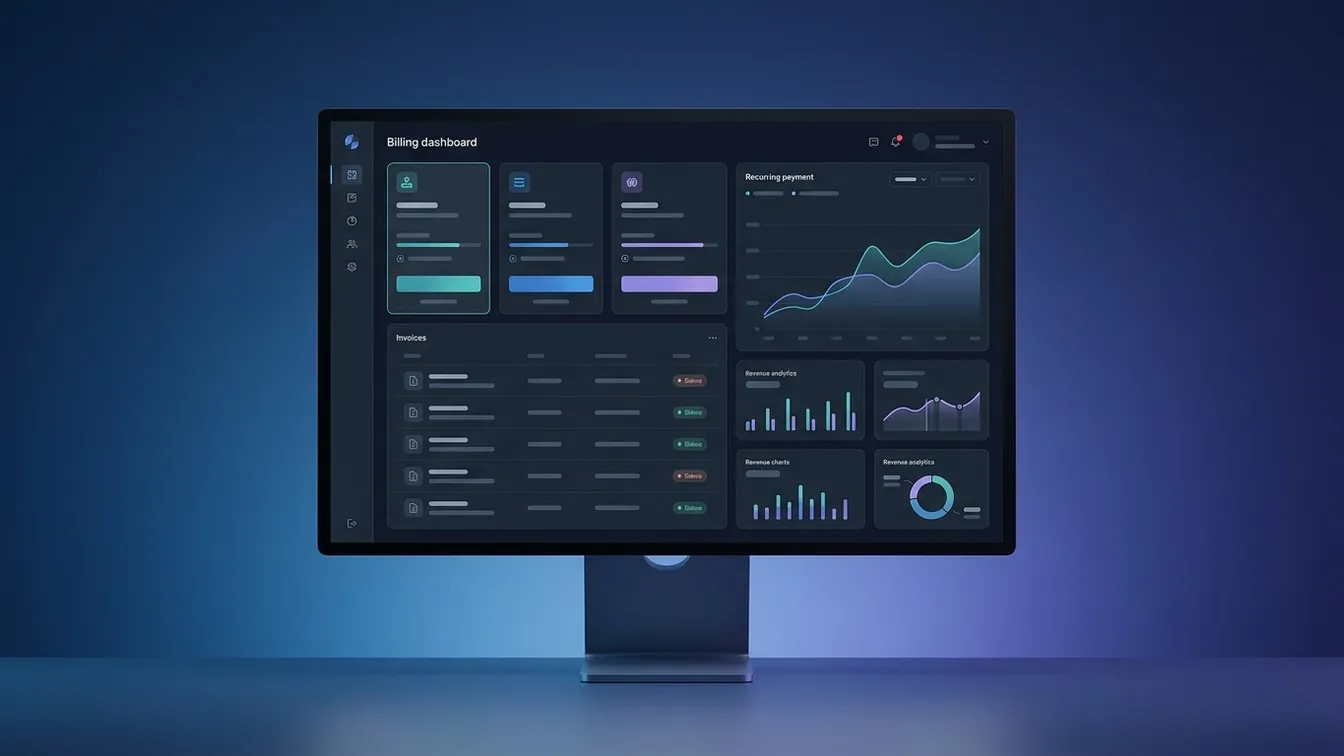
Billing is where SaaS products earn their revenue — yet it is one of the most consistently underestimated engineering challenges a product team will face. The initial integration looks simple: connect Stripe, set a price, accept cards. But as soon as you add a second pricing tier, a free trial, a mid-cycle upgrade, usage-based line items, or a coupon, the complexity compounds fast.
This guide is for product engineers and technical co-founders building or scaling SaaS products. It covers how to structure billing architecture to stay simple in the early days, how to extend it gracefully as your pricing evolves, and the operational concerns — dunning, failed payments, revenue reporting — that tend to surprise teams the first time they encounter them at scale.
Choosing a Pricing Model That Serves Your Business
Your pricing model is the contract between your product’s value and what customers pay. Getting the model right matters more than billing infrastructure details, because changing pricing later is expensive both technically and commercially.
Flat-rate subscription
The simplest model: one price, one set of features. Easy to communicate, easy to bill. Works well when customer value is homogeneous — every customer gets the same thing and the economics are similar. The limitation is that you leave money on the table with power users and may price out smaller customers.
Per-seat pricing
You charge per user or team member. This aligns cost with team adoption and scales naturally as customers grow. It is the dominant model for B2B SaaS. The engineering consideration is that your billing system must stay synchronized with your seat count in real time — a user deactivated at 3 PM on a Wednesday should not be billed for the rest of the month at the usual rate. Proration logic is essential.
Usage-based (consumption) pricing
Customers pay for what they use: API calls, storage, messages sent, transactions processed. This model lowers the barrier to entry and can generate very large invoices from high-volume customers. The engineering complexity is significant: you need reliable, tamper-resistant usage metering, often at high throughput. Any inconsistency in the meter creates revenue leakage or customer disputes.
Tiered and hybrid models
Most mature SaaS products combine models — a base subscription for platform access plus usage-based charges above a threshold. This captures the simplicity benefits of flat-rate pricing at lower volumes while extracting fair value from high-volume customers. Hybrid models require billing infrastructure that can handle multiple charge types on a single invoice.
Choose the simplest model that reflects your value delivery, and build your system to handle at least one layer more complexity than you need today.
Building on Payments Infrastructure You Can Trust
Unless your core product is payments, do not build payment processing from scratch. The PCI-DSS compliance burden alone makes self-hosted card processing untenable for most SaaS companies.
The managed billing layer
Tools like Stripe Billing, Paddle, Chargebee, and Recurly sit between your product and the payment rails. They handle the subscription lifecycle — trial periods, plan changes, invoice generation, proration calculations, and payment collection — and expose an API your application can use to trigger events. The cost (typically a percentage of revenue) is almost always less than the engineering time to build equivalent functionality.
What you control: your pricing configuration, the events that trigger plan changes (user upgrades, downgrades, cancellations), and the webhook handlers that keep your application state synchronized with billing state.
What the platform controls: payment method vaulting, card network integrations, invoicing, tax calculation (Stripe Tax, Paddle’s merchant-of-record model), and retry logic.
Synchronizing application and billing state
The most common source of billing bugs is state mismatch between your application database and your billing provider. A subscription that is active in Stripe but cancelled in your database — or vice versa — causes customer-facing errors or revenue leakage.
Build your synchronization around webhooks, not polling. Your billing provider fires events for every state change: invoice.paid, customer.subscription.updated, invoice.payment_failed. Write idempotent webhook handlers that update your application state based on these events, and design them to handle out-of-order delivery (webhooks are not guaranteed to arrive in sequence). Store the billing provider’s subscription ID and customer ID as indexed fields in your user/account table.
Managing the Subscription Lifecycle
A subscription passes through several states over its life: trial, active, past due, cancelled, and sometimes paused. Each transition has user-facing and engineering implications.
Free trials
Trials that do not require a payment method upfront convert at a lower rate than trials that collect card details on signup. The tradeoff is user acquisition volume versus conversion quality. Whatever you choose, be explicit in your product about when a trial ends and what happens next — surprise charges after a trial are the fastest way to earn a chargeback and a negative review.
Implement trial reminders at 7 days, 3 days, and 1 day remaining. These are high-ROI touchpoints that your email provider and billing system can automate with minimal engineering.
Upgrades and downgrades (proration)
When a customer changes plans mid-billing cycle, how do you handle the pricing difference? Most billing platforms calculate proration automatically, but you need to decide whether to apply it to the current invoice immediately or to the next cycle. Document your proration behavior in your pricing FAQ — it comes up in customer support tickets constantly.
For annual customers who downgrade, decide whether to issue a credit toward future invoices or a refund. Credits are simpler to implement; refunds require more customer service overhead but are often expected.
Pausing subscriptions
Churn is expensive. A customer who pauses for two months and then reactivates is far more valuable than a customer who cancels and churns. Add a pause option if your unit economics support it, especially for consumer-facing or SMB SaaS products. Most billing platforms support subscription pauses natively.
Dunning: Recovering Failed Payments Before They Become Churn
Payment failures are not rare — cards expire, are replaced after fraud, or hit limits. A significant percentage of SaaS churn is “involuntary churn”: customers who would have stayed, but whose payment failed and who were not effectively recovered.
Automated retry schedules
Billing platforms retry failed payments on a schedule, but the default schedule may not be optimal for your customer mix. A retry at day 1, 3, 7, and 14 after failure, with decreasing interval as the grace period expires, tends to perform well. Align your retry schedule with your support window so you can proactively reach out to customers with repeated failures.
In-app and email payment update prompts
The most effective dunning is proactive. Email the customer when their card expires — not after it fails. Show an in-app banner when their subscription status is past_due. Make the payment update flow frictionless: a one-click link that opens a secure Stripe-hosted page to update card details, no login required.
Hard and soft deletes
Define your grace period clearly. A subscription that has been past_due for 14 days has different treatment from one that has been past due for 2 days. Avoid immediately removing access on the first failed payment — this punishes customers with transient card issues. But do remove access definitively after the grace period expires, and make the reinstatement path clear.
Revenue Recognition and Financial Reporting
As your SaaS business grows, “how much did we make this month” becomes a more complex question than it first appears.
Bookings are the total contract value of deals signed in a period — useful for sales performance but not accounting revenue.
Billed revenue is what you invoiced — this is what shows up in your Stripe dashboard.
Recognized revenue (under ASC 606 / IFRS 15) is revenue earned by delivering service over a period. An annual subscription billed upfront is recognized ratably over 12 months — only 1/12 of the total is recognized in the month of sale.
For early-stage startups, this distinction may not matter much. But as you raise funding, prepare for a financial audit, or approach enterprise customers who require revenue-recognition-compliant reporting, you will need a chart of accounts and financial tooling that tracks these correctly. Chargebee RevRec, Stripe Revenue Recognition, and third-party tools like Ordway integrate with your billing platform and general ledger to automate this.
The Right Time to Build Your Own Billing System
The answer for almost all SaaS products is: never, or at very significant scale. Stripe and Paddle handle billions in payments for companies far larger than yours. Build your differentiated product, not billing infrastructure. The engineering time saved by using a managed platform funds multiple additional features that drive actual growth.
What you do build is the glue: the webhook handlers, the application state synchronization, the usage metering pipeline, the in-app upgrade flows, and the customer-facing billing portal. These are product decisions with real competitive differentiation — the payment rails underneath are infrastructure.
If you’re designing the billing and monetization architecture for a new SaaS product — or untangling a billing system that has grown too complex — let’s talk through your build. Explore how Nevrio approaches SaaS product development and cloud infrastructure services to see how we help teams build the right billing architecture from the start.
