
SaaS Onboarding Best Practices: How to Reduce Churn and Drive Product Adoption in 2026
August 24, 2026
Most SaaS churn doesn’t happen at renewal. It happens in the first two weeks, when a new user logs in, looks around, and quietly leaves because the product didn’t make its value obvious fast enough. Onboarding is a revenue problem, not a UX decoration — and in 2026, with product-led growth as the default go-to-market motion for SaaS, how well you get users to their first moment of value determines whether they pay, expand, or disappear.
This guide covers the patterns, engineering decisions, and measurement practices that move the needle on activation and reduce early-stage churn.
Why Onboarding Breaks Down
The failure mode is almost always the same: builders assume new users will invest the time to figure the product out. They won’t. Every friction point between signup and the first tangible result — a file processed, a report generated, a workflow saved — is a dropout risk.
Common engineering-side causes:
- Missing progressive disclosure. The UI shows every feature at once, overwhelming users before they’ve seen the core value.
- No contextual triggers. The product doesn’t know where in the journey the user is, so it can’t prompt them with the right guidance at the right moment.
- Onboarding bolted on after launch. In-app checklists and tooltips are added as an afterthought to a codebase that wasn’t designed for guided flows — they’re brittle and hard to personalize.
- Analytics blind spots. Teams measure signup rates but not activation events, so they can’t see where users drop.
Define Your Activation Milestone First
Before writing a single line of onboarding code, define what “activated” means for your product. Activation is the specific action (or set of actions) that correlates with long-term retention in your data.
For a project management tool, it might be “user creates and assigns their first task within 24 hours.” For a data analytics SaaS, it might be “user runs a query and views at least one chart in the first session.” For a communication tool, it might be “user sends a message to at least one teammate.”
This milestone becomes the north star for every onboarding decision. Every flow, tooltip, checklist item, and email is designed to move the user toward that event as fast as possible.
How to find your activation event
If you have historical user data, segment users who retained beyond 90 days versus those who churned early, and compare what they did differently in the first 72 hours. The actions that appear disproportionately in the retained cohort are your activation candidates. If you’re pre-launch, instrument generously and revisit after your first 200 users.
Engineering Patterns That Work in 2026
1. Segment-aware onboarding flows
Not all users have the same goal. A solo founder using your SaaS for the first time needs a different first-session experience than an enterprise admin provisioning 200 seats. Capture role and intent at signup (a two- or three-question modal, not a long form), and fork your onboarding flow accordingly.
On the engineering side, store the onboarding segment on the user object and expose it to your front-end state. Every guided element — tooltips, checklists, demo data — reads from that segment. This avoids the “one-size-fits-nobody” flow that treats a developer and a marketing manager identically.
2. Milestone-triggered in-app messages
Static product tours fired at login don’t reflect where the user actually is. A user who completes step 3 on day 1 and comes back two days later shouldn’t see the step 3 prompt again — they should see the step 4 nudge.
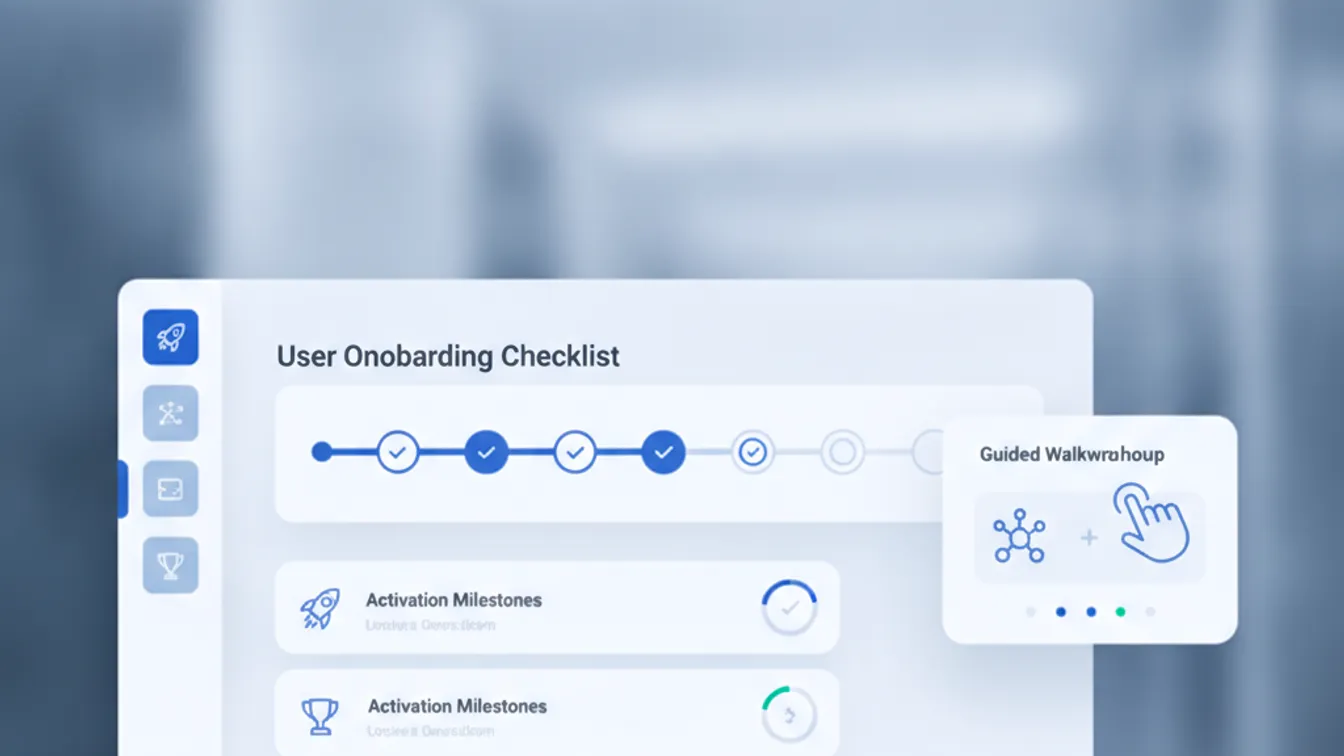
Implement milestone listeners: event handlers that fire when a user completes a key action and update their onboarding state in real time. The UI subscribes to that state and shows the next-most-relevant prompt. Tools like Pendo, Appcues, or Intercom Product Tours handle this out of the box; a custom implementation tracks completion events server-side and pushes state via WebSocket or SSE.
3. Demo data and sandbox environments
The fastest path to activation is letting users experience the product’s value with zero setup. Pre-populate the account with realistic demo data so users can run reports, see workflows, and test integrations immediately. This is especially effective for SaaS products with complex data models where the value is only visible once data exists.
The engineering lift: a “seed account” function that inserts a curated dataset on signup, tied to the user’s segment. Important — make it easy to clear the demo data with one click so power users don’t feel cluttered once they’re ready to use their real data.
4. Empty-state design as a guide
Every empty state — empty dashboard, empty list, empty project — is an opportunity to show the next step rather than a blank screen. Design empty states to include a call-to-action that moves the user toward the activation milestone. “You haven’t created a report yet → Create your first report” is more effective than a generic illustration with no clear action.
5. Behavioral email sequences
Not everything happens in-app. A five-email onboarding sequence tied to behavior (not just a fixed timer) recovers users who log in once and drift away. The triggers:
- Day 1 — no activation event: “Here’s a two-minute guide to your first [core action].”
- Day 3 — activated but not invited a teammate: “Your plan includes seats for your team — here’s how to add them.”
- Day 7 — hasn’t used a key feature: Surface one specific feature relevant to their segment.
- Day 14 — at risk of churning: Send a direct invite to a live demo or a short setup call.
Tie these to your activation events, not calendar days alone, so users who activate faster get different emails than those still finding their footing.
Measuring Onboarding Performance
Onboarding has its own metric set, separate from broader product analytics:
| Metric | What it tells you |
|---|---|
| Time to activation | How long from signup to the activation milestone |
| Activation rate | % of signups that hit the activation milestone |
| Onboarding completion rate | % of users who finish the guided checklist |
| Drop-off step | The checklist or flow step where users most often stop |
| Day-7 retention by activation cohort | Whether activation actually correlates with retention in your data |
Instrument these events in your analytics stack from day one. If you ship a product without tracking where users drop out of onboarding, you’re flying blind on your biggest churn lever.
Common Mistakes to Avoid
Launching with onboarding “version 1” and never iterating. Onboarding is a living system. Treat it like a conversion funnel and run structured experiments — test different empty state copy, different checklist ordering, different email subject lines, and measure activation rate as your north star metric.
Making the checklist too long. Five items maximum. More than that, and users see the checklist as a chore rather than a guide. Cut anything that doesn’t directly contribute to the activation milestone.
Requiring integrations or billing details before showing value. Every barrier between signup and the first “wow” moment is an exit ramp. Defer integrations and payment collection until after the user has experienced the core value at least once.
Not testing onboarding with real new users. Internal familiarity blinds teams to onboarding confusion. Run a session with someone who has never seen the product and watch where they stop, hesitate, or ask questions — those moments are your highest-priority fixes.
The Connection Between Onboarding and Product Architecture
Well-designed onboarding requires that the product was built for it. A codebase that treats new-user state, activation events, and segment routing as first-class concepts is far easier to instrument and iterate on than one where onboarding was retrofitted.
This is why teams building new SaaS products or rebuilding legacy platforms have a meaningful advantage: they can design activation tracking, demo data seeding, and behavioral triggers into the architecture from the start. If you’re scoping a custom software build or a MVP, the onboarding layer is worth designing in the initial sprint, not later.
Putting It Together: A Realistic Rollout Plan
- Week 1: Define your activation milestone. Instrument the event in your analytics stack. Baseline your current activation rate.
- Week 2–3: Audit every drop-off step between signup and activation. Ship empty state improvements and a simplified checklist.
- Week 4: Implement segment detection at signup and fork the flow for your top two user segments.
- Week 5–6: Build milestone-triggered in-app messages. Launch the behavioral email sequence.
- Ongoing: Run activation-rate experiments monthly. Review cohort data after every product change that could affect the onboarding path.
Onboarding isn’t a launch task — it’s a continuous product capability. The teams that treat it that way consistently outperform those that treat it as a checkbox.
If you’re building or re-architecting a SaaS product and want onboarding designed into the foundation rather than layered on top, start a project with Nevrio — we architect and build SaaS products with activation, retention, and growth instrumentation built in from sprint one.
