

SaaS Pricing Models Explained: How to Choose the Right Strategy for Growth in 2026
September 3, 2026
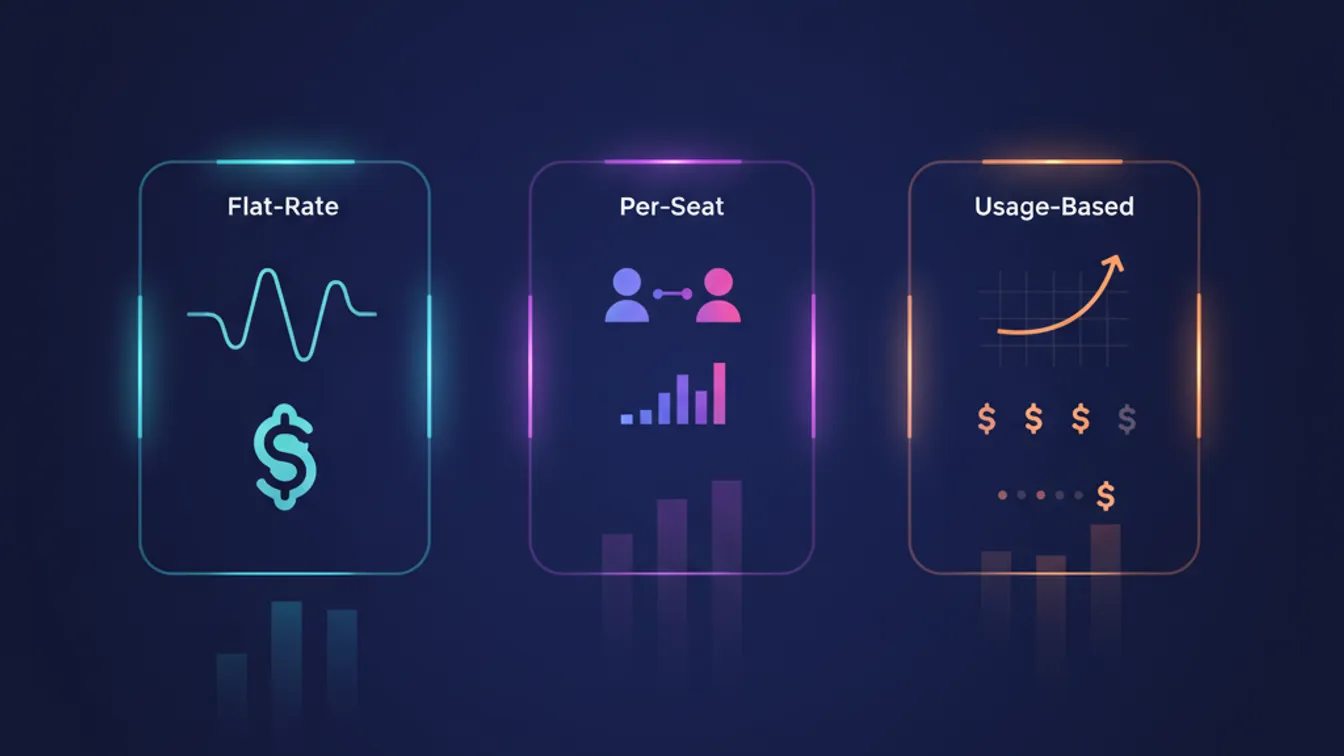
Pricing is product strategy made visible. It signals who you’re for, how you create value, and how you expect to grow. Yet most early-stage SaaS teams treat pricing as an afterthought—a number they pick once and rarely revisit. The result is often a misaligned model that either leaves money on the table or quietly kills expansion revenue.
In 2026, with buyers scrutinising every line item and usage-based billing becoming table stakes across categories, getting pricing right from the start is more important than ever. This guide breaks down the five primary SaaS pricing models, the scenarios where each excels or fails, and a practical framework for choosing the right one for your product.
Why Your Pricing Model Is a Product Decision
The model you choose doesn’t just affect revenue—it shapes your entire go-to-market motion:
- Sales cycle length — flat-rate is easier to sell; usage-based often requires a longer “land and expand” approach.
- Customer success focus — per-seat models drive licence expansion; usage-based models demand you obsess over adoption and consumption.
- Engineering complexity — metered billing needs reliable usage instrumentation from day one.
- Predictability — flat-rate gives you smooth MRR forecasting; consumption billing introduces volatility.
None of these are reasons to avoid a model—they’re inputs to design around.
The Five Core SaaS Pricing Models
1. Flat-Rate (Fixed Monthly Fee)
How it works: One product, one price, all features included.
Best for: Simple, broadly-used tools with a clearly defined use case—time-tracking apps, simple email tools, or niche productivity software where the value is consistent regardless of team size.
Upside: Easy to sell, easy to forecast, zero billing complexity.
Downside: You can’t capture more value as customers grow. A five-person startup and a 500-person enterprise pay exactly the same amount, which caps your expansion revenue and makes churn especially painful.
2026 context: Flat-rate is increasingly rare for horizontal SaaS products. You’ll see it most in early-stage products that haven’t yet segmented their market, or in niche verticals where the customer base is homogenous.
2. Per-Seat (Per-User) Pricing
How it works: Charge per monthly active user or licence assigned.
Best for: Collaboration tools, project management software, CRMs, HR platforms—any product whose core value multiplies with team adoption.
Upside: Revenue scales naturally with customer growth. Easy for procurement teams to budget. Strong incentive to drive user adoption.
Downside: Seat minimisation is a real behaviour. Teams share accounts, restrict licences, or delay rollouts to keep costs down. This can cap adoption and frustrate your product-led growth motion.
2026 context: Per-seat is still the dominant model for B2B SaaS, but it’s being supplemented—or replaced—by hybrid models at the high end, where enterprise deals mix a platform fee with per-seat tiers.
3. Usage-Based (Consumption) Pricing
How it works: Customers pay for what they use—API calls, data processed, transactions, messages sent, or compute consumed.
Best for: Infrastructure, developer tools, AI/ML products, communication APIs, and any platform where value is directly proportional to volume. Think Twilio, Stripe, and OpenAI.
Upside: Lowers the barrier to try (start free or small), aligns cost with value delivered, and unlocks massive expansion revenue without a single upsell conversation.
Downside: Revenue becomes harder to forecast. Finance teams at enterprise customers hate unpredictable bills. You need mature billing infrastructure and real-time usage dashboards from the start.
2026 context: Usage-based pricing is the fastest-growing model in the market, particularly in AI-native and API-first products. If your product has a clear, measurable unit of value, this model is worth serious consideration.
4. Tiered Pricing
How it works: Multiple fixed plans (Starter / Growth / Enterprise, for example), each with a different feature set, seat count, or usage cap.
Best for: Almost every horizontal SaaS product with a broad customer base. Tiers let you serve different buyer personas—solopreneurs, scaling teams, enterprise procurement—without maintaining separate products.
Upside: Balances predictability with differentiation. Creates a natural upgrade path. Lets you gate high-value features for higher tiers.
Downside: Tier design is genuinely hard. Too few tiers and you leave money on the table; too many and buyers stall at the choice. Feature-gating the wrong things creates frustration.
2026 context: Tiered pricing is table stakes for any SaaS product targeting multiple customer segments. The real craft is in defining the value metric that gates each tier—seats, projects, data volume, AI credits—rather than arbitrary feature flags.
5. Freemium
How it works: A permanently free tier with real utility, monetised through paid upgrades.
Best for: Products with strong network effects, viral loops, or high volume top-of-funnel—note-taking apps, design tools, communication platforms.
Upside: Lowest possible acquisition cost. Builds brand awareness and community. Powers product-led growth.
Downside: Free users are expensive to support at scale. Conversion rates from free to paid are typically low (2–5%). Without careful free-tier design, you end up with a large support burden and no revenue.
2026 context: Freemium works when your product genuinely gets better with more users (virality) or when the free tier creates a natural ceiling that motivates an upgrade. It’s a distribution strategy first—not a pricing strategy.
A Decision Framework: Which Model Fits Your Product?
Work through these four questions:
1. What is the natural unit of value your product delivers? If it’s “a seat at the table,” lean per-seat. If it’s “transactions processed” or “queries answered,” lean usage-based. If the value is uniform, flat-rate or tiered works.
2. How broad is your customer range? A homogenous user base (solo founders) suits flat-rate. A wide range (solopreneurs to enterprise) demands tiered pricing to capture the spread.
3. How important is predictable MRR at your current stage? Early-stage startups often benefit from the simplicity of flat-rate or tiered billing, saving usage-based complexity for a later maturation stage.
4. Do you have the infrastructure to support the model? Usage-based billing requires instrumentation, a billing engine (Stripe Billing, Lago, or a custom solution), and real-time usage dashboards. Per-seat requires user management and licence enforcement. Budget for the engineering cost of the model you choose.
Common Pricing Mistakes That Kill SaaS Growth
- Setting price by gut feel, not willingness-to-pay research. Run surveys, analyse competitor positioning, and run pricing experiments before locking in.
- Gating features that customers need to see value. Onboarding friction kills activation. Move the “aha moment” before the paywall.
- Never revisiting pricing after launch. Pricing should be reviewed at least annually, and after every major product expansion.
- Ignoring expansion revenue. The best SaaS businesses earn more from existing customers every year. Design your model to make expansion the path of least resistance.
Building the Product Behind the Price
Pricing model clarity only matters if the product is built to deliver on it. The engineering decisions that underpin usage-based billing, seat management, or freemium conversion flows need to be made early—they’re hard to retrofit.
If you’re building a SaaS product and want to get the architecture right from the start—billing infrastructure, feature flagging, usage instrumentation, or the full MVP—the team at Nevrio has done this across SaaS and startup products across multiple industries.
Start your SaaS project with a team that knows how to design for growth from day one—or talk to our SaaS team about your pricing and product architecture questions.
